- Flat White
- Posts
- Face value
Face value
Performance reviews are back, and with them, the annual ritual of being blindsided by feedback that apparently existed all year but never made it into a single conversation. Your rating was never just about your work. It's the product of budget politics, rating curves, and opinions from people who couldn't pick you out of a lineup.


The Aussie Corporate & Pick & Scroll News
March 17, 2026
Was this email forwarded to you? Sign up here!
Good morning AusCorp. Performance reviews are back, and with them, the annual ritual of being blindsided by feedback that apparently existed all year but never made it into a single conversation. Your rating was never just about your work. It's the product of budget politics, rating curves, and opinions from people who couldn't pick you out of a lineup.
In this fortnight's edition, we're also unpacking what performance improvement plans actually mean for the person on the receiving end and whether KPMG's decision to offshore 200 executive assistants to the Philippines is the cost play it looks like on paper.
💡 Brains Trust
1. Face value
Performance review season has a way of surfacing feedback that apparently didn’t matter until your pay rise depends on it. Your manager, who has been positive all year suddenly has concerns. A senior leader you've only run into in the elevator left a very “mid” comment and there no real examples anyone can actually bring up.
A performance review isn't really a review of your performance. It's the corporate intersection between your output, your manager's political (and social) capital, the company's budget position, whatever rating distribution HR has decided is statistically appropriate, and more often than not, the opinions of people who probably operate in another city. Your actual work is one input among several, and not always the loudest one.
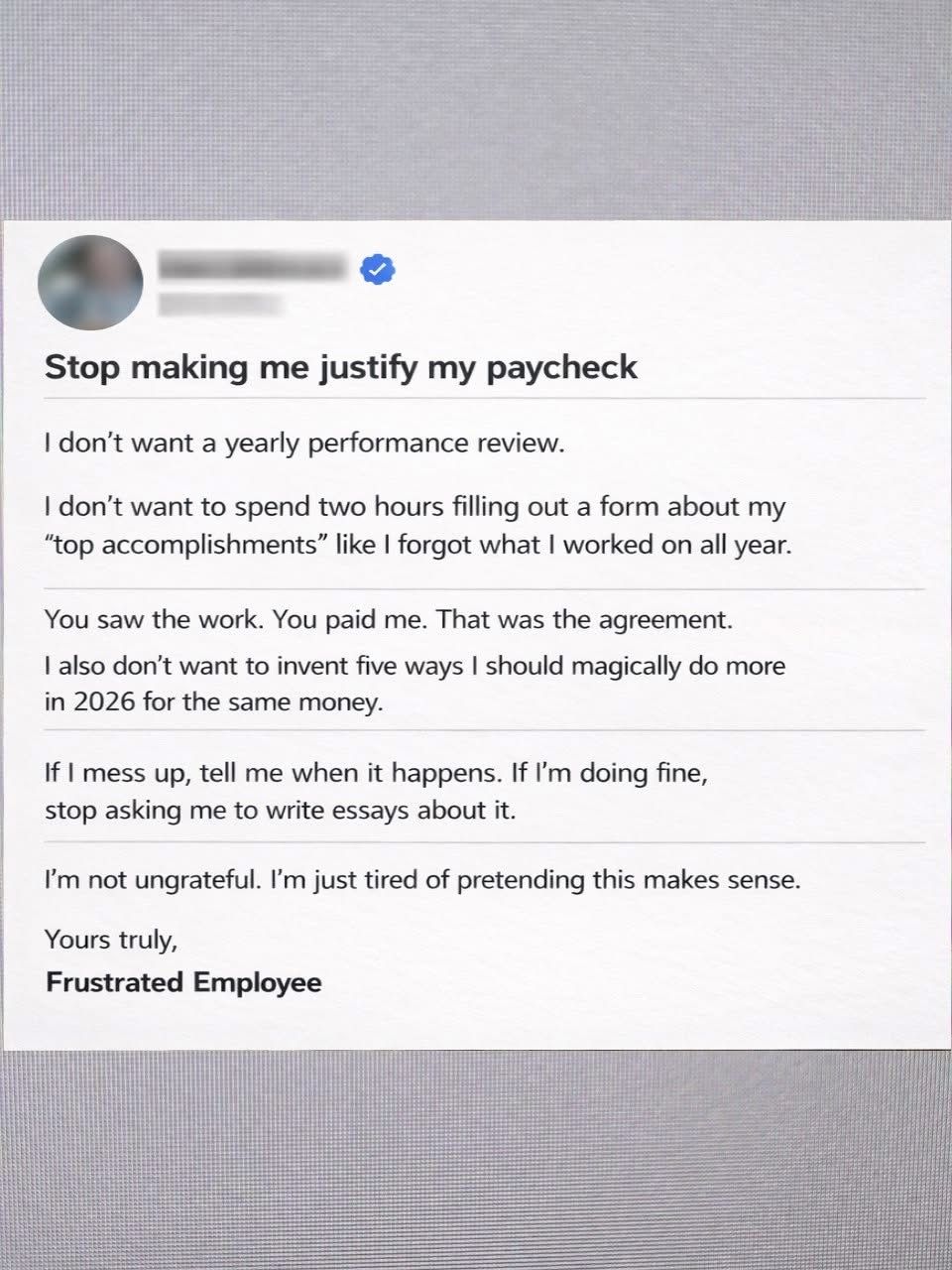
The ones who figure it out early tend to do better, not because they work harder, but because they stop treating performance reviews as a meritocracy and start treating it as a conversation that needs managing.
That means keeping a running record of what you've delivered across the year, not just at review time. It means making your work visible to the people whose opinions end up in that meeting room, not just your direct manager. It means having the development conversation in March, not waiting to hear what got decided in October. None of this should be necessary in a well-run organisation, but in most organisations it is.
Feedback withheld all year and delivered in a review isn't feedback. It's a paper trail. If something genuinely needed addressing, the time to raise it was when it happened. Managers who save it for the formal process are either conflict-averse or building a case, and either way, employees tend to be the last to know. The most useful thing a leader can do is make the review the least surprising conversation of the year.
💡 The Lobby
Commonwealth Bank job listings are currently down 45% over the last 6 months
Atlassian’s headcount grew by 7,347 over the last 2 years - that’s up 50%.
KPMG Australia’s biggest hiring rounds are in February and November
2. Exit strategy
Someone watched three colleagues go through performance improvement plans in two years with all three gone before the 90 days were up. Now they've been told they're on an informal one themselves and want to know if there's any genuine intent behind the process, or whether it's just paperwork.
A formal PIP, particularly once HR is involved and the language starts getting specific, is largely a documentation exercise. Organisations don't typically invest in the PIP infrastructure for people they're actively trying to retain. The targets are often constructed to be just credible enough to justify the process and just difficult enough to ensure the outcome. Whether that's the case in every situation is hard to say.
What if you’re on an informal PIP though. Nothing is formally documented yet, which means the conversation is still a conversation. An informal PIP is sometimes a genuine warning from a manager who wants to flag something before it escalates, and occasionally it is exactly what it looks like. Either way, the response is the same: get clarity on what's actually being asked and get it in writing if you can.
The other thing worth saying is that none of this means the role is worth fighting for. Sometimes the more useful question isn't how to survive the process but whether surviving it changes much.
3. Remote work
KPMG has made 200 of its executive assistants redundant, replacing them with offshore staff based in the Philippines. This is supposed to save them $17M per year.
EA costs in Australia are high and on paper a lot of the work looks transferable. But the partners who rely most heavily on EAs tend to have working styles that are idiosyncratic. There's particular meeting rhythms, unwritten preferences and the kind of institutional knowledge that takes months to build and is almost never documented anywhere.

A good EA is not just managing a calendar. They are managing a person, often one who has very little patience for being managed poorly. Whether a Philippines-based EA working across time zones can replicate that kind of proximity is the real question, and most people seem to think the answer is no.
Scheduling tools, automated travel management and better self-sufficiency are already changing what senior leaders actually need from support staff. The offshore model may be imperfect, but it is also arriving at a moment when the role itself is changing. If a partner's effectiveness depends entirely on someone knowing their work preferences and lifestyle habits however, that is arguably a dependency problem as much as it is an EA problem.
So what happens if productivity drops for the partners most dependent on high-touch support and suddenly the hidden costs accumulate? KPMG would not be the first firm to find the savings smaller than its spreadsheet suggested.
This Flat White was made with

Every morning at 8AM, we’ll send you an email with everything you need to know across Australian business, global and company news in a 2-minute read.
📊 AMP’s Finest
The war with Iran is dragging on, the Strait of Hormuz remains closed to normal shipping, and every day that it stays that way puts more upward pressure on oil prices and more downward pressure on confidence. Share markets are sliding, petrol prices are climbing, and the RBA is expected to hike rates later today. For most Australian households, all three are arriving at once.
Source: ABS, AMP
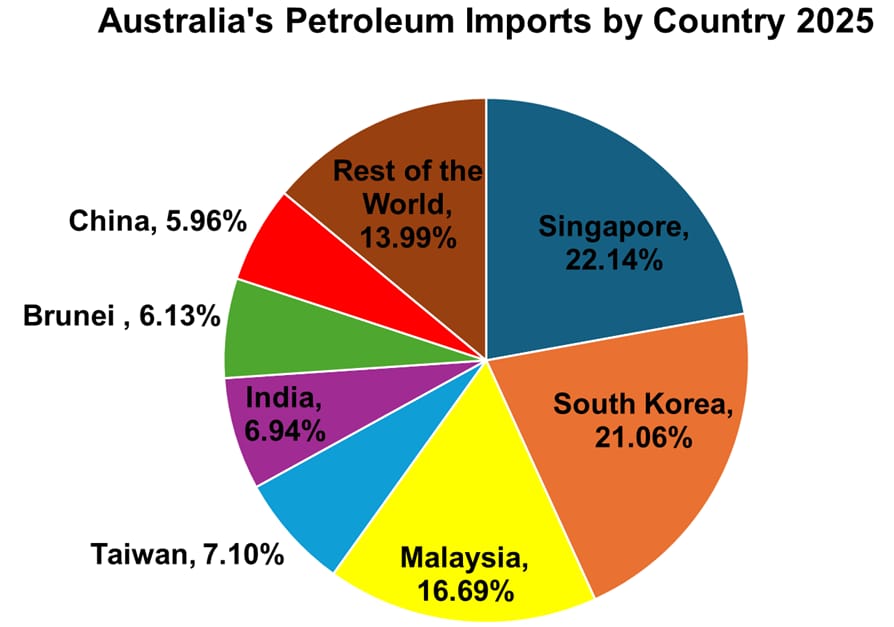
Australia sits in an awkward middle position given all this global conflict. As a major gas and coal exporter, the country benefits from higher energy prices. But most of the petrol Australians actually put in their cars is imported, refined in Asia from Middle Eastern crude, and the supply chain for that is now genuinely fragile. Australia holds about a month's worth of fuel reserves. If Asian refiners start prioritising their own populations over export customers, we’re in trouble.
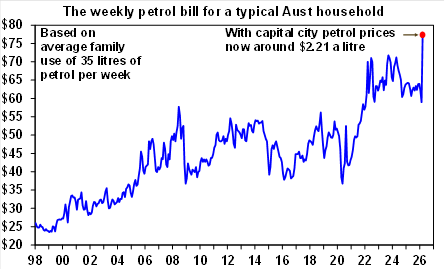
For the average household with a mortgage and a car, it’s going to suck. Petrol is already at record weekly costs, adding around $78 a month to the average household budget compared to February. A rate rise on top of that adds roughly another $110 a month in mortgage repayments. Together that is close to $190 a month in extra costs landing simultaneously, on a consumer base that was already spending cautiously before any of this started.
Source: Bloomberg, MotorMouth, AMP
If that was helpful at all, you can listen to the AMP Econosights podcast here, featuring Shane Oliver, Diana Mousina and My Bui.
🗞️ On Your Minds
🇦🇺 TOP AUSTRALIAN NEWS RECAP
A surge in Greek yoghurt demand has led to Australian shortages, driven by health trends and viral recipes despite expert opinions on its necessity. LINK
Victoria plans to enforce the right to work from home for small businesses. LINK
Ad fraud is causing Australian advertisers substantial financial losses as it affects all digital platforms with bot activity over 50%. LINK
The rising cost of living in Australia is driving families towards camping as caravan sharing platforms face demand exceeding supply. LINK
Young Australians' trust in democracy is waning as less than half believe it's preferable. LINK
🌏 THE ODD PICKS
Apple is releasing its latest batch of emojis including 8 new icons - a distorted face, a treasure chest and a 'fight cloud', will be available in the next iOS 26.4 update.
A Christchurch couple found $232,000 in sealed plastic bags and decided to spend it on a huge holiday hand it in to police.
A new niche dating 'trend' has landed in New York... Wrestling Speed Dating.
8 nutrition mistakes hurting your gut microbiome.
How to trick your brain into doing something you’re avoiding.
✍️ Feedback Loop - share your thoughts
What did you think of this month's Flat White? |
If you have want to provide more detailed feedback or have any topics that you want to hear more about, you can let us know HERE.
Was this email forwarded to you? Sign up here