- Flat White
- Posts
- Microwave tuna
Microwave tuna
In this month’s edition, we count several thousand cheese toasties, cover some of the redundancies that made headlines in the past month, some office etiquette and the importance of the Acknowledgement of Country before meetings.


The Aussie Corporate & Pick & Scroll News
March 04, 2026
Was this email forwarded to you? Sign up here!
Good morning AusCorp. And just like that we’re almost at the end of Q1.
In this month’s edition, we count several thousand cheese toasties, cover some of the redundancies that made headlines in the past month, some office etiquette and the importance of the Acknowledgement of Country before meetings.
As always, our inboxes and DMs are always open should you have any questions you’d like answered or any ideas you want addressed.
We held our first Aussie Corporate volunteering session last week and the response surprised even us. We sold out in a day and had 300 people join the waiting list within 48 hours. However, only the first 60 could take part.

Hosted in what’s arguably one of the best offices in Sydney thanks to our friends at Salesforce, we partnered with Eat Up Australia and made 2,200 cheese sandwiches across two sessions. Within the week, 19 schools received our fresh cheese toasties for students who would otherwise have gone without. It’s simple work, but it has a very real impact.
Volunteering doesn’t get much easier. The Eat Up team comes directly into your office with everything prepared, making it accessible for corporate teams to contribute in a tangible way.
If sandwich-making or running isn’t your thing, that’s fine. The AusCorp Events team have more in the pipeline for the next few months (we’re hearing Puppy Yoga and some exercise in a very red room). You heard it here first.
💡 Brains Trust
1. It’s giving routine
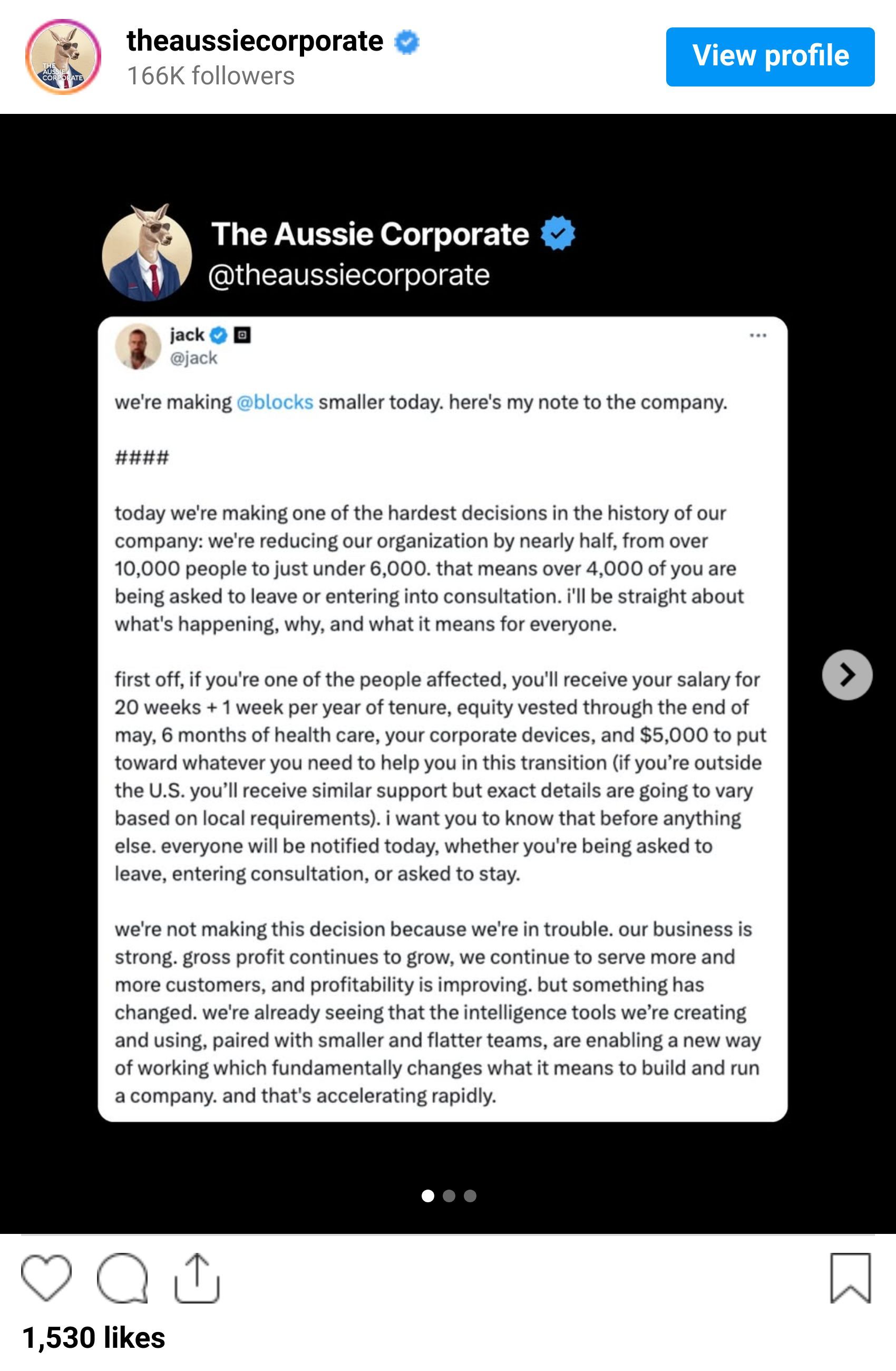
If you follow our Instagram, it probably feels like every second headline this month has been about job cuts. Square/Block halving its workforce and blaming AI-driven efficiency, CBA with deep cuts in HR and tech, also because of supposed AI gains. Macquarie thinking they’re super lowkey but everyone knows they’ve been doing it quietly and consistently over the past year. Redundancies always read like carnage, so while Australian unemployment numbers are supposedly low, we attribute this jump partially to us just being more aware of the changes because they’re public and they’re also happening at big names. It’s no surprise when you consider that many of these firms (usually in tech) overhired during the last few years and are now reframing cuts as efficiency gains, followed by a neat share price bump.

From the perspective of a large Australian corporate, there are only certain windows where cuts make sense. February through May before EOFY resets. Then again around September or October once results are out and new budgets are set. You avoid peak reporting periods, manage workflow disruption and contain the impact before the next planning cycle. It’s rarely random.
What many forget is that redundancies are expensive. Under the National Employment Standards, payouts range from 4 to 16 weeks based on tenure, plus notice periods and unused leave. A single redundancy can equate to 6 to 9 months of salary upfront and companies don’t recoup that cost quickly. That’s why when leaders communicate clearly and look after people on the way out, it stands out. If you haven’t read Jack Dorsey’s rant on X already, have a geez. It’s good for optics, but it also reflects how significant these decisions are financially. Either way, check in on your friends. This wave likely isn’t done yet.
2. Necessary respect or corporate checkbox?
We’ve had multiple requests to address this properly, so here it is. A clear majority of companies now practise an Acknowledgement of Country in meetings, and most of the feedback we received was positive. Many see it as a simple way to recognise the Traditional Owners of the land, pay respect to Elders past and present, and acknowledge history. It takes 30 seconds. Complaining about the inconvenience of that probably misses the point.
Where frustration has become evident is when the AOC becomes performative. When it’s read off a script with no understanding. When it’s mandated for every meeting, including weekly 1:1 Teams calls. When people use the extra 30 seconds to grab coffee or dial in late. That’s when it starts to feel like a compliance exercise rather than genuine respect. Several Indigenous professionals we spoke to said the discomfort doesn’t come from the practice of the acknowledgement itself, it’s more the forced delivery with no follow-through. Words without action. No community engagement. No procurement shifts. No tangible support and just awkward looks around the room or pretend attempts to check your phone. Just a line at the top of the agenda.
There’s also a question of scale. Most agree that large forums should include it. But does it lose meaning in small internal meetings? Does repetition without education dilute impact? Some organisations have tried personalising it, sharing what the land means to them or briefly explaining its purpose. That tends to resonate more than reading a paragraph off a slide. If we are going to do it, it needs context and consistency. And at the bare minimum, we should be capable of accommodating 30 seconds in our day to acknowledge the land we’re on. But we can also agree that the harder conversation is what happens after that.
This Flat White was made with

Every morning at 8AM, we’ll send you an email with everything you need to know across Australian business, global and company news in a 2-minute read.
3. Desk dining
Have you ever had a colleague sit down next to you and unpack something that slowly takes over the entire floor? Apparently it got bad enough at Telstra Health that a senior executive had to send out comms banning staff from eating at their desks altogether.
There’s the etiquette side of it, sure. But there’s also the practical side. It’s generally better not to eat at your desk. Your brain needs a break. Stepping away, even for 15 minutes, helps to reset focus. The issue is that return-to-office has brought back habits that people picked up at home. When you’re WFH, no one cares what you microwave. In an open-plan office with recycled air and someone monitoring how long you’re away from your desk for, it’s a different question.

So where’s the line? Butter and toast is breakfast so it’s on the same page as cereal. A pastry in the morning will just make people jealous. A hot meat pie might get a few looks but survives. A laksa, seafood stir fry or boiled egg? That’s when you’re definitely getting judged. Even if it smells good to you, it doesn’t mean the 40 people around you share that view. Add in the gym bro reheating tuna and rice at 10.45am and suddenly everyone has a meeting to go to.
That said, not everyone wants to socialise at lunch. For some, staying at the desk and getting through work is the reset. Work can be a form of escapism. We get that. If your food isn’t particularly “strong” and you’re unsure, you can always ask. A quick “is this okay here?” goes a long way with your colleagues. Then it’s back into the grind, hopefully without triggering a fire drill.
📊 The Draft Pick
Winter is coming, which means the NRL and AFL are back in focus. The NRL is already underway following its high-stakes pre-season jaunt to Vegas last weekend; the Bulldogs snatched a controversial win over the Dragons, while the Knights enjoyed a more comfortable victory over the Cowboys. The rest of the NRL cohort, along with the first AFL bounce of the year, kicks off this Thursday night.
February was a landmark month for the Australian Winter Olympics team. The team just wrapped up its most successful Winter Olympics in history, finishing with 3 Gold, 2 Silver, and 1 Bronze medal, placing Australia 14th on the overall tally. Norway topped the table with a staggering 18 Gold medals in what was an extremely successful Games for the Scandinavian powerhouse.

AOC / Chris Hocking
The Australian Men’s cricket team was bundled out of the T20 World Cup in the group stages following shock losses to Zimbabwe and Sri Lanka. It’s okay though - the Ashes are still where they belong, and that’s what really matters.
Looking ahead, the Matildas are back on home soil this month as Australia hosts the AFC Women’s Asian Cup. Meanwhile, the F1 circus will no doubt overcome any logistical hurdles (given they aren't exactly short of money to throw at a problem) to kick off the season at Albert Park in Melbourne this weekend.
📊 AMP’s Finest
There’s been a lot of geopolitical noise this year. The US has been involved in tensions across Nigeria, Venezuela, Greenland and now Iran. Over the weekend the US and Israel launched broad attacks on Iran after talks over its nuclear program failed. Conflicts in the Middle East aren’t new, but what matters for markets is whether oil supply is actually disrupted.
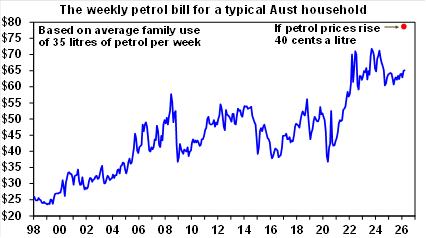
Iran produces roughly 4-5% of global oil and gas, and exports a meaningful share of that. If fighting spills over into key shipping routes like the Strait of Hormuz, oil prices could jump sharply. That’s when it becomes an economic issue. A US$40 rise in oil prices would likely add about 40 cents a litre to Australian petrol prices. That flows through quickly. Petrol gets more expensive within a week or two, households spend more at the pump and less everywhere else.
There are two broad paths from here. The more likely scenario is a short and contained conflict where tensions cool and oil prices settle back down. In that case, markets wobble but recover. The higher risk scenario is a prolonged conflict that seriously disrupts oil supply. Oil could spike toward US$150 a barrel and shares would likely fall hard. For Australians the most immediate impact would be higher petrol prices. That would lift inflation in the short term but also slow spending, which makes the Reserve Bank’s job harder. It’s just another reminder that global events don’t stay global for long.
If that was helpful at all, you can listen to the AMP Econosights podcast here, featuring Shane Oliver, Diana Mousina and My Bui.
🗞️ On Your Minds
🇦🇺 TOP AUSTRALIAN NEWS RECAP
ME Bank has apologised for an email that showed enthusiasm about passing on the RBA rate hike, as customers face higher interest from 7 February ahead of most lenders. LINK
Australian companies are adopting a 4-day work week to improve employee satisfaction and productivity. LINK
Gen Z is driving inflation pressures for the RBA, facing high unemployment and unaffordable housing as they spend on discretionary goods like frozen yoghurt and matcha. LINK
91% of employers use AI for monitoring, yet only 9% of workers are aware of being surveilled. LINK
Bunnings has partnered with startup Elsewhere Pods to sell $26,100-$42,900 modular backyard homes and tap into the growing demand for fast-build permit-free housing. LINK
🌏 THE ODD PICKS
Here is a list of the best airlines for long-haul flights.
The no. 1 healthiest bread with the most fibre and protein, according to a dietitian.
Sydney cafés cracked multiple spots in the World’s 100 Best Coffee Shops rankings, with Only Coffee Project Crows Nest landing in the global top five.
5 things to remove from your nightstand tonight for better sleep and a calmer mind.
These were the most popular baby names in 1926.
✍️ Feedback Loop - share your thoughts
What did you think of this month's Flat White? |
If you have want to provide more detailed feedback or have any topics that you want to hear more about, you can let us know HERE.
Was this email forwarded to you? Sign up here